
Why a new Constitution is required in Ecuador
A Constituent Assembly should be convened, voting Yes in the popular consultation of November 16

In the 2008 referendum, I was one of the few people who campaigned against the approval of the Montecristi Constitution. The constitution obtained 63.9% support in the referendum (despite the fact that a few months earlier 81.7% had supported the convening of a Constituent Assembly).
The reasons I opposed the 2008 Constitution are the same why I now consider that a Constituent Assembly should be convened, voting Yes in the popular consultation of November 16. This is despite the fact that Ecuador has already had 20 Constitutions in 195 years, while the country that used to be the paragon of freedom and democracy, the United States, has only had one in 238 years.
A Constitution must establish the structure and bases for the functioning of the State, and the freedoms and rights of citizens against the State, establishing limits to prevent the abuse of power (the origin of these are the Magna Carta of 1215, which established in writing legal guarantees and limited the arbitrariness of the British monarch). But it should not have an ideological or political bias, as Chile discovered, as it has first rejected a constitutional text prepared by a left-dominated Assembly, and then another draft that was deemed too conservative.
The Montecristi Constitution fails in all these areas: it has a clear leftist bias (”socialism of the 21st century”), excessively strengthens the power of the Executive by creating a hyper-presidentialist regime, puts in check essential rights of citizens such as the right to property, and it imposes nationalist, indigenist and pseudo-scientific criteria (such as “ancestral and alternative health” and opposition to genetically modified foods).
A profound mistake was the creation of the so-called “Council of Citizen Participation and Social Control” (CPCCS), which took away the powers of parliament to approve the control authorities, foisting this power on a Council supposedly elected from non-partisan people, but which in practice led to dishonest campaigns by the Correista movement (the “blue league” candidates) and the Social Christian Party.
In addition, it promoted the balkanization of Ecuador, by establishing “plurinationality”, and recognizing a parallel system of “indigenous justice”.
In the economic sphere, the fundamental mistake was to limit the possibility of investment by the private sector (national or foreign) in what it called the “strategic sectors”, which included sectors as vital as electricity generation and distribution, telecommunications, the radio spectrum, hydrocarbons and minerals. This has been one of the factors that has led to the electricity blackouts. It also prevented private trade of carbon credits, thus limiting investment in preserving forests and biodiversity.
The expropriation of property was not prohibited, and it did not even establish that in the event that a property is expropriated, it should be compensated in a fair manner (Art. 376).
The violation of contractual clauses and international treaties led to countless lawsuits by multinational companies against the Ecuadorian State, which has generated claims for damages for billions of dollars.
This all has led to a reduction in private investment, which has kept growth and adequate employment low. Foreign direct investment in Ecuador is not even a tenth of what it is in neighboring countries. GDP per capita, which was essentially the same in Colombia, Ecuador, and Peru in 2007, is now much lower in Ecuador ($6,873 in Colombia, $6,711 in Peru, and $5,999 in Ecuador in 2024, measured in constant 2015 dollars).
It advocated that the Social Security Institute (IESS), which already faces a huge actuarial deficit, should finance universal social security and universal retirement.
Yielding to clerical pressure, gay marriage was not allowed, although the Constitutional Court later ruled that this violated the rights of same-sex couples.
The core of Correa’s Constitution was to seek total control of all the powers and functions of the State, and the references to “sumak kawsay”, “good living”, “rights of nature”, plurinationality and “Pacha Mama” were nothing more than propaganda elements to cover up this central objective.
The new Constitution should take the best aspects of the two constitutions prior to the Montecristi constitution (1979 and 1998), but update them (for example, establishing the US dollar as legal tender). The independence and separation of powers between the Executive, Legislative and Judicial branches must be clearly established, with mechanisms of checks and balances.
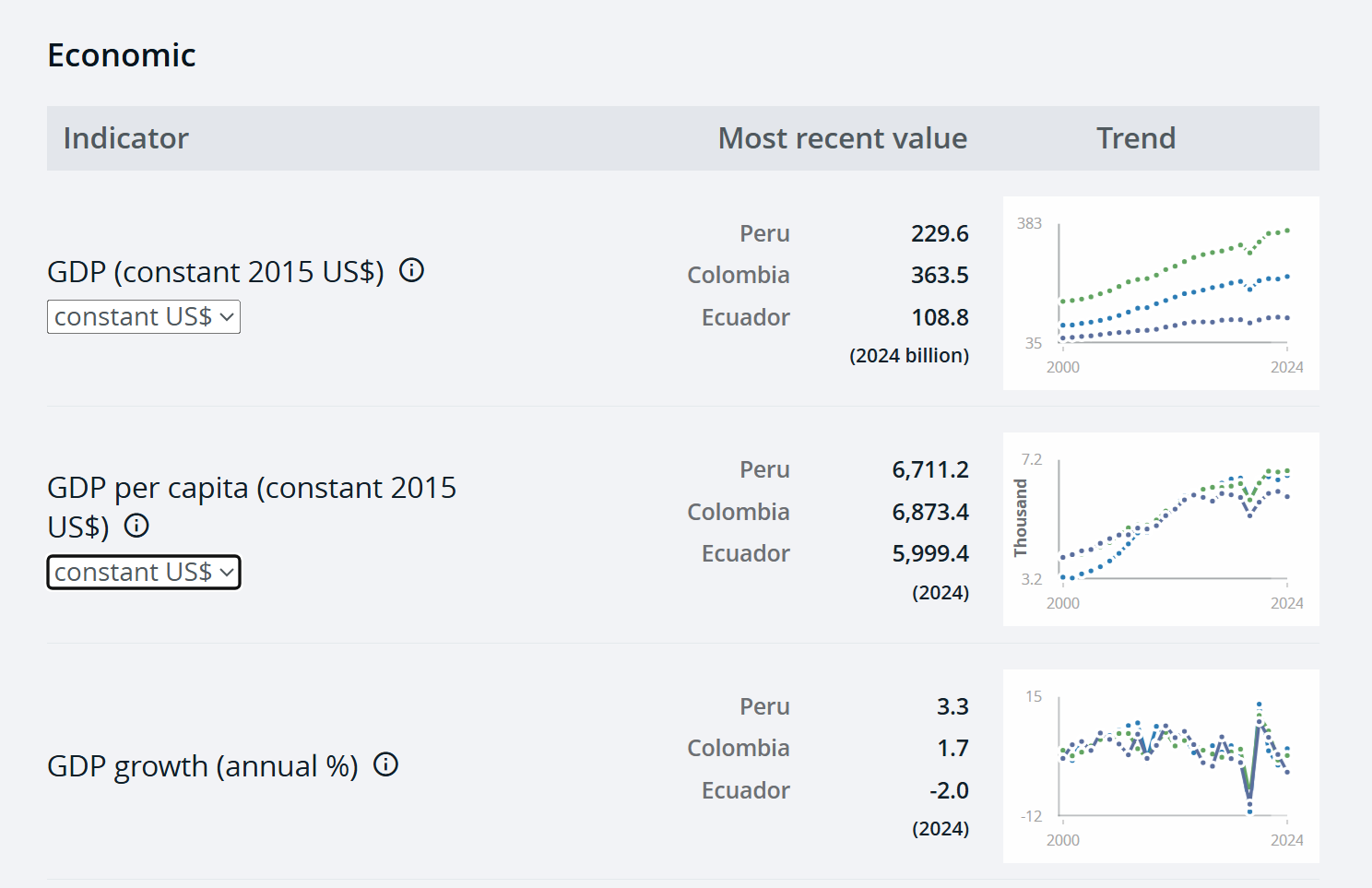
Source: World Bank, https://data.worldbank.org/?locations=PE-CO-EC