
Abandoning multilateralism could generate a soft power crisis for the United States
The Donroe Doctrine (Part II)

This second installment analyzes how the abandonment of multilateralism and the dismantling of US soft power, along with external interventions and threats, are weakening its alliances and favoring its strategic competitors.
Abandoning multilateralism and soft power
Almost in the same days as the intervention in Venezuela, on January 7 the United States announced the withdrawal from 66 international institutions, including 31 associated with the United Nations, and another 35. This is in addition to the previous abandonment of the Paris Agreement on Climate Change, UNESCO, the World Health Organization (WHO), the United Nations agency for Palestine (UNRWA), the Human Rights Council (UNHRC), among others.
Among the most troubling recent departures are the Framework Convention on Climate Change (UNFCCC), in charge of international climate negotiations (a treaty, by the way, that was ratified by the U.S. Senate in a 92-0 vote), as well as the Intergovernmental Panel on Climate Change (IPCC), which produces a regular scientific report on the progress of climate change.
It also ordered the withdrawal from several United Nations Committees and Commissions, including the Economic Commission for Latin America and the Caribbean (ECLAC), UNCTAD, the United Nations Department of Economic and Social Affairs (ECOSOC), and UN Women.
In addition to withdrawing from international organizations, the Trump administration has also eliminated or attempted to eliminate several U.S. entities working internationally, including the U.S. Agency for International Development (USAID), other State Department development assistance efforts, the Millennium Challenge Corporation (MCC), and the U.S. Development Finance Corporation (DFC); the closure of the Voice of America and the other international public media; and the dismantling of the Inter-American Foundation, the United States Institute for Peace (which he later renamed the “Donald J. Trump Institute for Peace”), among other entities. All of this is weakening U.S. “soft power,” as I wrote in an article published in Costa Rica’s “Derecho en Sociedad” magazine.
The dismantling of USAID and cuts to the World Food Programme (WFP) will lead to the deaths of millions of people in developing countries. A study by UCLA researchers found that these cuts could lead to the deaths of 14 million people by 2030, including 4.5 million children under the age of five.
The elimination of USAID was executed by Elon Musk and the so-called “Department of Government Efficiency” (DOGE); this led Bill Gates to declare “ the world’s richest man has been involved in the deaths of the world’s poorest children”.
Attack on Venezuela, threats to Greenland and other countries
In the days following the capture of Venezuelan dictator Nicolás Maduro and his wife, the Venezuelan diaspora had hoped that this would represent a return to democracy in Venezuela. However, and consistent with the new “National Security Strategy,” democracy, human rights, or the well-being of the Venezuelan people do not appear to have been a factor in the military intervention.
President Trump himself, in a press conference, mentioned the word “oil” 27 times, and the word “democracy” zero times. In practice, although he claimed that the United States would control Venezuela and even posted that he was the “interim president of Venezuela,” the Armed Forces and the territory of Venezuela remains under firm control of the Chavista dictatorship, including Maduro’s vice president, Delcy Rodríguez. Other figures of Chavismo, such as Diosdado Cabello, and the Minister of Defense Vladimir Padrino, remain in their positions.
Venezuelan oil is heavy, and investment to increase production will cost hundreds of billions of dollars and take several years. One company, Exxon, said that Venezuela was “uninvestable” under the current legal and political conditions.
So, doubt remains as to what the real reason for the intervention was. Some analysts point to the existence of rare minerals and earths; others to the opposition to the Russian, Chinese and Iranian presence in Venezuela; still others believe that the operation was to distract from the domestic political problems of the United States (documents on Jeffrey Epstein that compromise Trump; growing economic problems; Trump’s approval dropping below 40%). If the latter was the goal, it was a failure, given that the majority of the population opposes this military intervention, and even higher percentages are against the U.S. occupying Venezuela or managing its natural resources.
The same can be said of threats to take Greenland by force: the cost would be to destroy NATO, and the supposed benefits (access to minerals and rare earths; defense against possible Russian or Chinese incursions) can be achieved within the framework of existing treaties and agreements between Denmark/Greenland and the US. Analyst Ian Bremmer has highlighted that at the height of the Cold War, the United States had 15 bases on the island, with 15,000 troops; while today it only maintains one base with 150 people. The vast majority of the U.S. population opposes an invasion of Greenland (75% according to a CNN poll); even higher percentages in Denmark and Greenland.
The truth is that the US government is undermining its military alliances and soft power, something that could only benefit its strategic adversaries (China, Russia, Iran).
How the new U.S. foreign policy impacts Ecuador
The Daniel Noboa administration has made efforts to align itself with the foreign policy of Trump and Rubio. In trade matters, a trade agreement is being negotiated that would reduce the 15% tariff surcharge on a significant number of Ecuadorian exports to the U.S. (oil has always been exempt; it was eliminated for certain tropical products that the U.S. does not produce—bananas, cocoa, coffee, mangoes, and pineapples—and negotiations are underway to eliminate it for an additional 50% of exported products). In exchange for the exemption, Ecuador is committed to reducing tariffs in sectors key to the U.S. (machinery, technology, and chemicals) and to improving trade facilitation, intellectual property protection, and labor/environmental standards.
Additionally, Noboa has sought U.S. support in the fight against drug trafficking and organized crime groups (there was even talk of establishing a base, although this would be unconstitutional; the “No” vote won in the November 16 referendum on this issue). The dismantling of USAID and the suspension of loans and guarantees for climate change and environmental issues will adversely affect Ecuador, but Noboa is seeking additional financing and investment. For now, the U.S. has supported Ecuador’s agreement with the IMF (from which $3.3 billion has already been received).
[On January 27th ICE agents attempted to breach the Ecuadorean Consulate in Minneapolis but were rebuffed; the Ecuadorean Foreign Ministry filed a formal complaint].
(*) English translation of the article published on January 28, 2026, in “Gestión Digital”, the economic and business analysis supplement of “Primicias”:
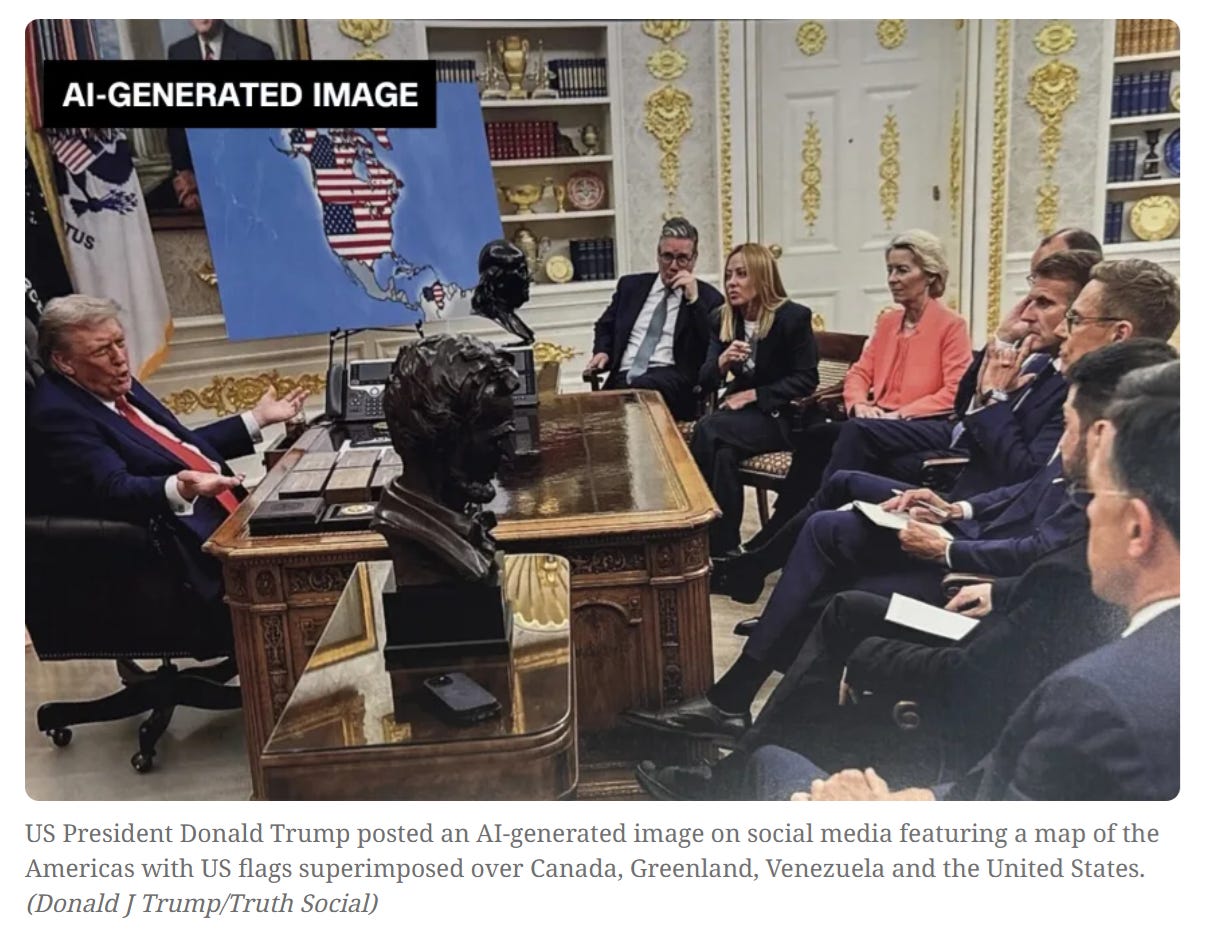
President Trump posted a fake AI-generated image featuring a map of the western hemisphere with U.S. flags superimposed over Canada, Greenland and Venezuela.